AI answers rarely quote whole articles. They lift small passages that look complete, trustworthy, and easy to verify.
That changes how you should write in 2026. If your best point is buried in a long paragraph, or separated from its source, you may rank and still never get cited. This guide serves as a manual for AEO and answer engine optimization, where good AI content structure is the foundation of being cited. It turns a page into a set of clear answer blocks following a structured content model that both people and machines can use.
Key Takeaways
- AI citations depend on extractable passages, not just page rankings: structure content into self-contained sections with clear question or claim headings, answer-first format, and nearby proof.
- Use tables for comparisons, lists for steps, and FAQs for queries, enhanced with schema markup, to make content easy for models to quote confidently.
- Keep passages standalone by avoiding vague pronouns, naming entities explicitly, and including in-line attribution with sources, dates, and E-E-A-T signals.
- Boost citability with original insights, first-party data, visible update dates, and conversational language that matches user AI prompts.
Why rankings alone don’t win AI citations
AI citation in AI search is a retrieval problem before it’s a ranking problem. A page can rank well, yet still lose because the answer is buried, vague, or detached from proof. Both HubSpot’s GEO best practices and Kime’s guide to LLM extraction point to the same shift: AI systems pull sections, not full narratives.
Classic SEO still matters. Internal linking and topic clusters, along with crawlability, page titles, and topical depth, build authority to help your page get found. But once a model sees the page, it looks for a passage it can reuse with confidence. Generative engine optimization ensures specific user intent is satisfied at the passage level, so section-level clarity matters more than clever prose.
Long intros, loose headings, and broad summary paragraphs can still work for organic traffic. They often fail for AI retrieval because the answer arrives too late. In AI search, people ask full questions and follow-ups, so vague sections lose ground.
This comparison keeps the difference clear:
| Focus | Traditional SEO | AI retrieval and citation |
|---|---|---|
| Main unit | The full page | The passage or section |
| Winning signal | Relevance and authority | Extractable answer plus proof and semantic relevance |
| Best heading style | Topic coverage | Clear question or claim |
| Best support format | Depth across the page | Nearby evidence, tables, FAQs |
| Common failure | Thin content | Buried answer or weak attribution |
Classic SEO gets you into the candidate set. Strong structure helps you get picked from it.
The page elements AI can quote with confidence
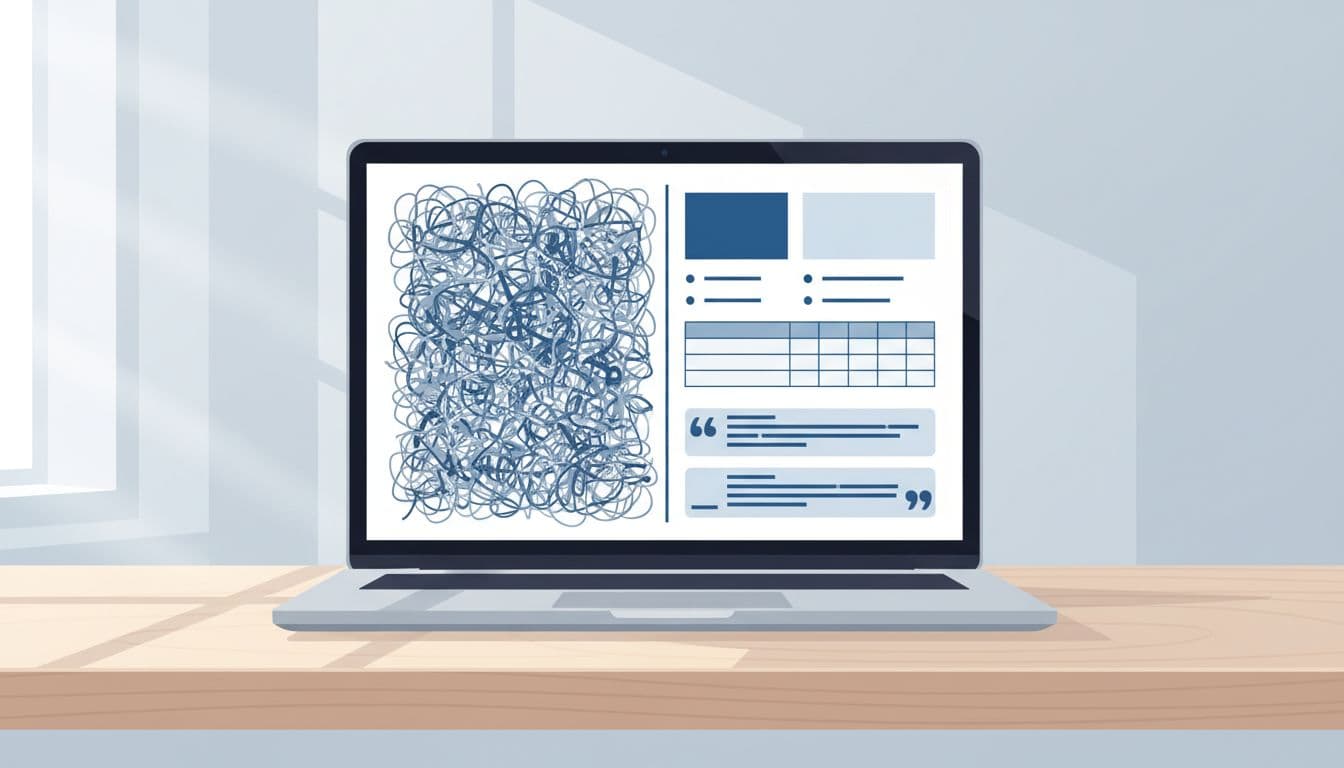
Each piece of modular content should work like a mini answer page. If a model reads only that section, the meaning should still hold.
Start with headings. Your H2 should name the exact question or claim the section resolves. Use question headings when they match real queries. Use direct statement headings when the section is analysis or comparison. Avoid labels like “Overview” or “Key takeaways” unless the section truly is one.
Then put the answer first. If you’re defining a term, define it in the first sentence. If you’re making a claim, state it early. After that, support it. A clean claim-evidence pattern is easy to quote because it keeps the conclusion and the proof together.
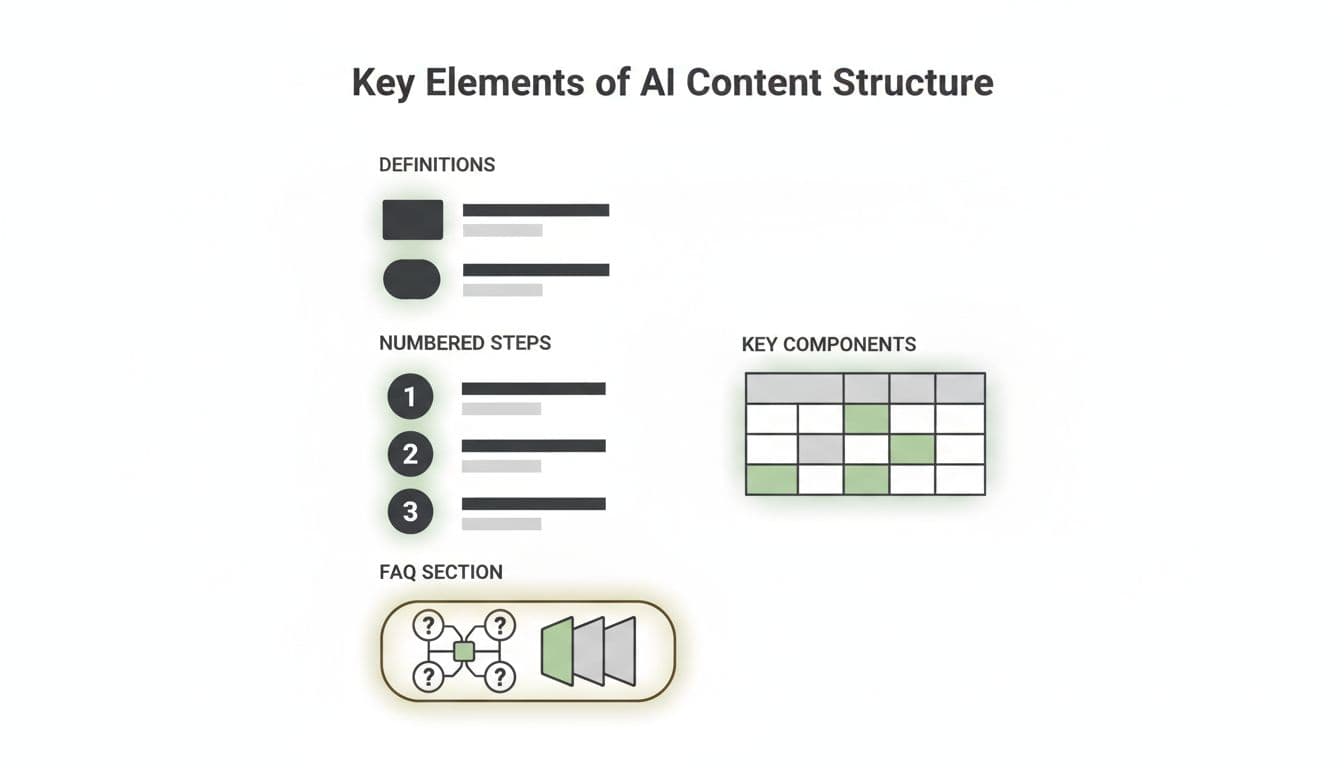
Good structure also uses the right format for the job. Tables help when the reader, or the model, needs a side-by-side comparison (opt for machine-readable tables). Lists help with steps or criteria. FAQs help match the exact way buyers phrase questions in ChatGPT, Perplexity, and AI Overviews. Enhance them with schema markup, such as FAQ schema, to help models understand the page layout. Keep each FAQ answer short, direct, and self-contained.
Attribution matters just as much as formatting. Name the source in the sentence, not only in a link dump at the end. Show the author, the reviewed-by expert if relevant (bolstering E-E-A-T), and the updated date on the page. Maintain a consistent brand voice throughout. For technical or regulated topics, a visible research section helps both trust and traceability. The guide to AI visibility and citations also recommends a visible sources block when claims need verification.
A passage becomes quoteable when it is complete, attributable, and easy to lift without losing meaning.
One more rule matters: use real entities. Say “AI Overviews,” “Perplexity,” or “law firm SEO,” not “it” or “this approach” when the reference could blur. This practice feeds into knowledge graphs. Machines handle named things better than vague pronouns.
Make every passage stand on its own
Content chunking means a useful section doesn’t depend on what came before it. That’s a big difference between essay writing and citation-friendly writing. RAG systems require these chunks to be self-sufficient.
If a paragraph says, “This also improves performance,” a model has to guess what “this” means. If the paragraph says, “A comparison table improves AI citation odds because it keeps options and differences in one extractable block,” the passage stands on its own.
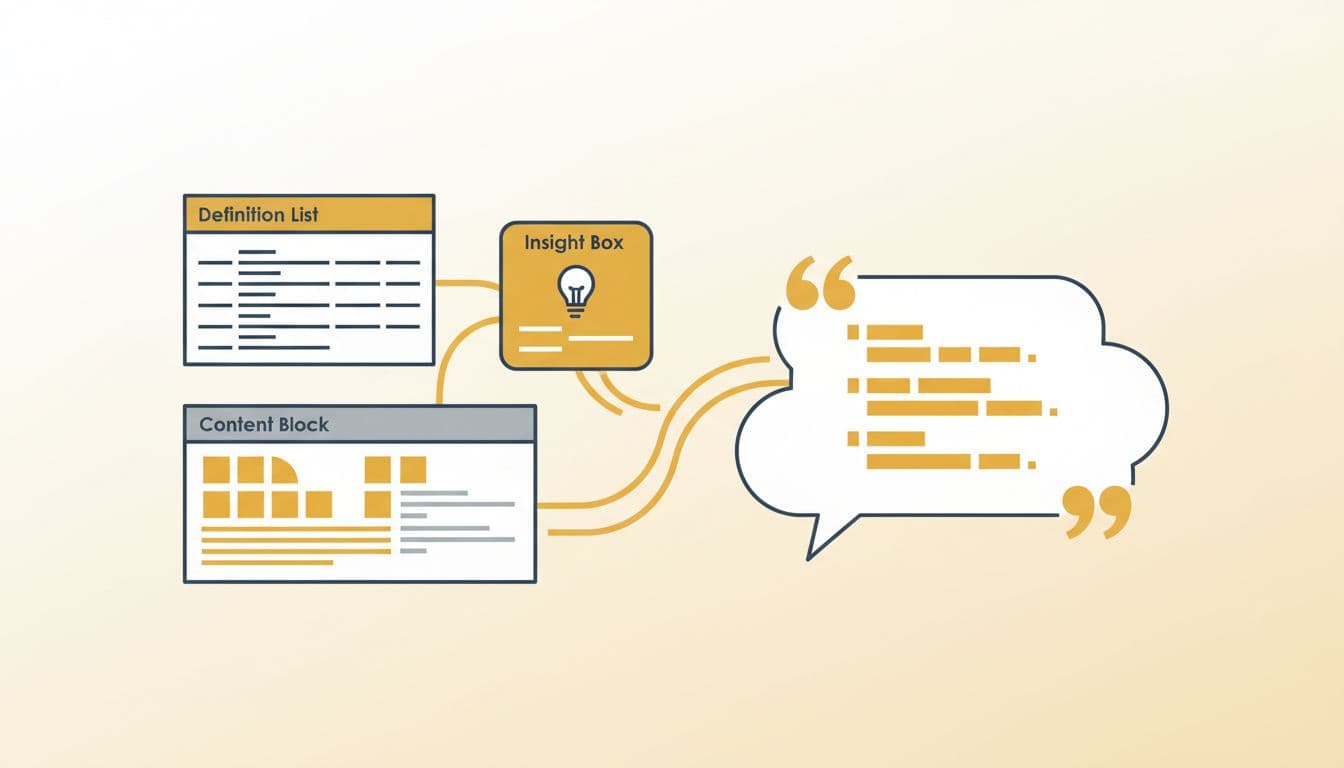
Poorly structured vs AI-friendly content
Here is the kind of paragraph AI often skips:
Many brands are trying new content methods for AI, and this is becoming more important as search changes and user behavior shifts.
Here is a version with a better shot at being quoted:
AI-friendly content works best when each section answers one question in one to two sentences, then backs that answer with a named source, date, example, or first-party data point.
The rewrite names the subject, makes a direct claim, and shows how the claim can be checked. It also makes sense when copied out of context.
Original insight is the other edge. AI can summarize public information from many sites. It cites unique observations when they are clear and well-labeled. That could be data-driven insights from a client benchmark, an editorial test, a short framework, or a founder’s expert comment. This approach also helps capture featured snippets. If you have first-party data, include the timeframe, sample, and method. Otherwise, the claim is hard to trust.
Content freshness still matters, too. GenOptima’s 2026 playbook highlights quick-answer blocks near the top of the page and steady update cycles for semantic clarity on pages that target active AI search behavior. Add a visible “Last updated” date, refresh stale examples, and revise passages when tools or interfaces change.
Frequently Asked Questions
Why don’t high-ranking pages always get cited in AI search?
AI search prioritizes retrieval of complete, verifiable passages over full-page relevance. A page may rank well but lose citations if answers are buried in long paragraphs or lack supporting evidence. Strong AEO ensures sections satisfy specific intents at the passage level.
How should headings be formatted for better AI extraction?
Use headings that directly name the question or claim the section answers, avoiding vague labels like ‘Overview.’ Question-style headings match real user queries, while statement headings work for analysis. This helps models identify and lift precise answers.
What makes a passage quotable by AI models?
A quotable passage is self-contained, with the answer stated first, followed by evidence like named sources, data, or examples. Include in-line attribution, avoid pronouns, and use formats like tables or lists for clarity. Original insights and freshness further boost trust and selection.
Why use FAQs and schema markup in AI-optimized content?
FAQs mirror exact user questions in tools like ChatGPT or Perplexity, making them prime for citation. Schema markup signals structure to models, improving understanding and extraction. Keep answers short, direct, and standalone for maximum quotability.
How does content freshness impact AI citations?
AI favors current, updated content with visible ‘Last updated’ dates and refreshed examples. Stale passages lose semantic relevance in evolving search behaviors. Regular updates align with active AI queries and maintain authority.
Final takeaway
Success in AI search blends traditional keyword research with modern prompt engineering preparation. The pages AI quotes are usually the easiest pages for humans to scan. Put the answer first, write headings that carry meaning, and keep each claim next to its proof.
Then add clear attribution and at least one original insight that another site can’t copy from memory. Use conversational language to match how users interact with AI. When a passage reads cleanly on its own and aims for snippet selection, it has a much better chance of becoming the cited source instead of the ignored result.