If you’re trying to rank higher with SEO, keyword coverage alone won’t carry the page as far as it used to. Search engines now look for meaning, context, and the relationships between the ideas on the page, making entity SEO a key part of modern ranking factors amid the rise of AI Overviews.
That is where entity SEO matters. It helps search engines understand what your content is about, how the pieces connect, and whether your page adds real depth to the topic, which is essential for being cited in AI Overviews.
Key Takeaways
- Entity SEO builds on traditional SEO by focusing on entities (people, places, things, concepts) and their relationships, helping search engines understand context and boosting rankings in Google and AI Overviews.
- Entity mapping—identifying core entities, attributes, and connections—builds topical authority, uncovers content gaps, and ensures high-quality coverage of user intent without keyword stuffing.
- Write naturally for readers first, then use the entity map to verify depth; tools like Rank Math Content AI speed up mapping for efficient workflows.
- Strengthen E-E-A-T with organization schema, knowledge graph optimization, and precise
about/mentionedmarkup to enhance brand visibility and rich results. - Analyze competitors’ entity networks to spot gaps, prioritizing relationships over word count for standout performance in AI Overviews and zero-click searches.
What entity SEO adds to traditional optimization
Entity SEO builds on familiar SEO work as part of Semantic SEO. You still need solid keyword research, user intent alignment, useful copy, and clean on-page structure. What changes is the way you frame the topic to better match user intent rather than just word matching.
An entity is a person, place, thing, or concept that search engines can identify. In other words, a keyword is often just the label, while the entity is the meaning behind it. When someone searches “brisket smoker temperature,” Google is not only matching words. It is trying to understand the entities involved, such as brisket, smoker, temperature, smoke, wood, and cooking method, then checking whether your page connects them in a credible way.
This is especially relevant with AI Overviews, where natural language processing (NLP) allows search engines to identify key entities and relationships to satisfy informational intent. These AI Overviews pull from pages with high entity density to deliver direct answers right at the top, often fueling zero-click search scenarios where users get what they need without clicking through.
That shift matters because better rankings often come from clearer context, particularly for AI Overviews that prioritize entity connections over simple relevance. If your page only repeats a phrase, it may look thin. If your page explains the main entities and shows how they relate, it gives search engines more confidence in what the page covers, helping it serve informational intent effectively.
A simple way to think about entity SEO:
- It helps search engines connect keywords to real-world meaning.
- It puts more weight on relationships between concepts.
- It rewards pages that cover a topic with clarity and depth.
This is why entity SEO feels different from older keyword-first tactics within Semantic SEO. It is not a replacement for strong SEO basics. It is the next step after them, especially as AI Overviews evolve. If you want a broader look at the concept, Rank Math’s entity SEO guide and Search Engine Land’s definitive overview both give helpful background.
Search engines don’t only ask, “Does this page mention the term?” They also ask, “Does this page understand the topic?”
For marketing teams, that changes content planning. A page now needs more than phrases that match a query. It needs the right concepts, the right structure, and the right connections between them to stand out in AI Overviews.
How to rank in Google and AI Overviews with entity mapping
Entity mapping is the practical part of entity SEO. It is the process of breaking a topic into the main entities, describing them with attributes, and then mapping how they connect. This approach builds topical authority by showing search engines a deep, interconnected understanding of the subject, which helps pages rank higher in Google and AI Overviews.
Take a topic like “how to smoke brisket.” The core entities might include brisket, smoker, wood, temperature, rub, smoke ring, and Texas BBQ. Those are the nouns and concepts that define the subject. Once you identify them, you can describe each with useful attributes. Brisket may include cut, grade, and fat content. Wood may include type, burn rate, and flavor. Temperature may include the ideal cooking range, which in this example was presented as 225 to 235 degrees Fahrenheit.
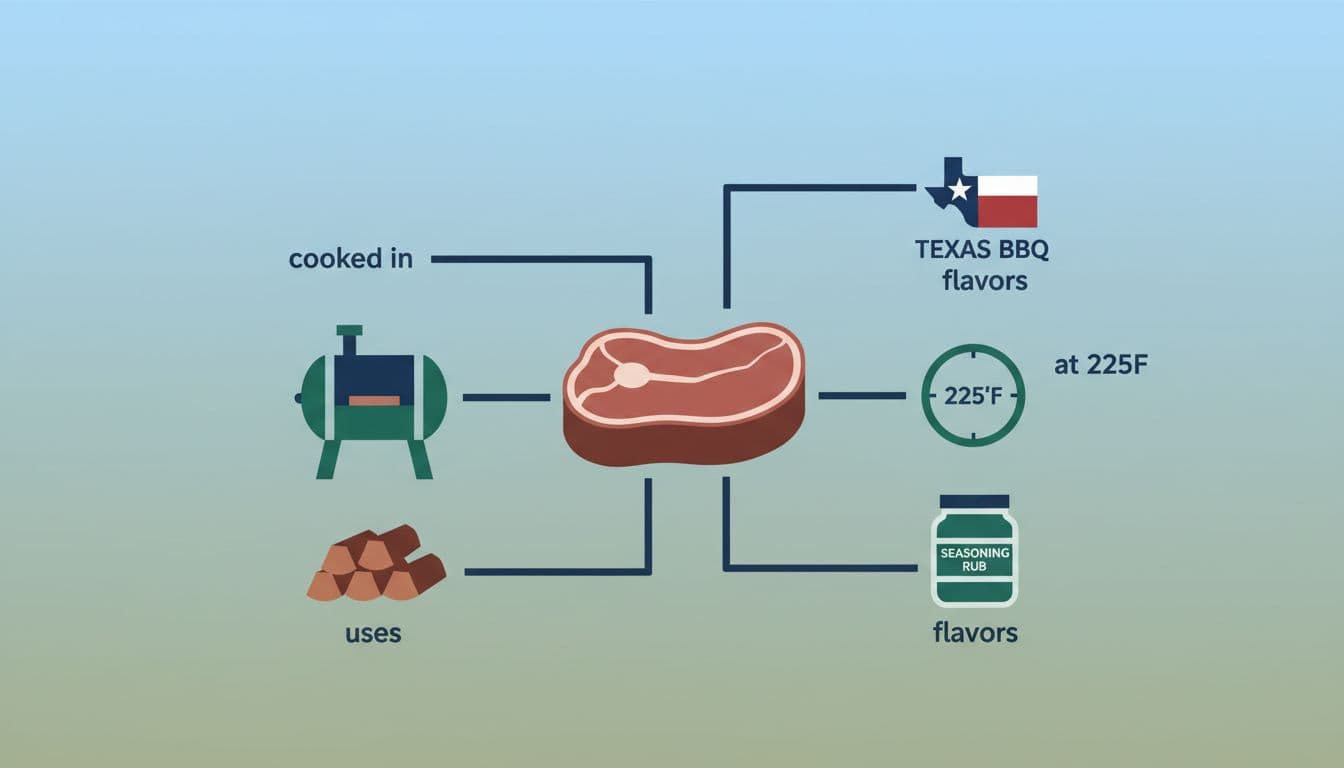
The next step is the one most teams skip. You map the relationships:
| Entity | Related entity | Relationship |
|---|---|---|
| Brisket | Smoker | Brisket is cooked in a smoker |
| Smoker | Wood | The smoker uses wood to create smoke |
| Wood | Brisket | Wood adds flavor to brisket |
| Brisket | Temperature | Brisket requires a steady cooking temperature |
| Rub | Brisket | Rub is applied before smoking |
| Smoke ring | Brisket | A smoke ring forms during proper smoking |
| Texas BBQ | Brisket | Texas BBQ often features smoked brisket |
That table gives you more than an outline. It gives you a checklist of meaning. Mapping entities this way ensures high-quality content that qualifies for top rankings, as it naturally captures long-tail keywords like “best wood for smoking brisket” or “Texas BBQ brisket rub recipe” while staying aligned with the primary user intent.
Once those connections are visible, content gaps are easier to spot. Maybe the draft explains smoker setup but ignores the role of wood. Maybe it mentions Texas BBQ but never ties that style to post oak or brisket. Those missing links can make a page feel incomplete, even if the target phrase appears in the right places. Filling them strengthens topical authority and delivers the high-quality content search engines reward.
For teams managing high-volume content, entity mapping also improves consistency. Different writers can cover the same topic without drifting into thin or off-topic copy. A good map keeps the page centered on the topic the way search engines understand it, incorporating long-tail keywords seamlessly to boost relevance and rankings.
How to write with an entity map without sounding robotic
A common mistake is to treat entity SEO like a script. That usually leads to stiff, repetitive copy. The better method is simple: write for the reader first, then review the draft against the entity map.
Start with a natural draft. Focus on the user intent, the real questions behind the search, and the details that make the page useful. Providing direct answers to these questions in clear entity relationships creates high-quality content that search engines reward. After the first draft is done, compare it to the map. Check whether the main entities are present, whether their attributes are clear, whether the important relationships are stated in plain language, and whether the content offers enough direct answers for featured snippets.
That review stage often reveals small but important misses. For example, if a section on choosing wood never explains how wood flavor affects brisket or why a Texas BBQ style often points to a specific wood type, the content may sound fine to a casual reader but still leave out useful context.
The brisket example makes this easy to see. A sentence like “When smoking brisket in a Texas BBQ style, choose wood such as post oak for a traditional flavor profile” connects three entities in one natural line. It does not feel forced because the relationship is relevant to the task, and it delivers a direct answer that could earn featured snippets or visibility in zero-click search results.
The same applies to later sections in the article:
- A prep section should connect brisket and rub.
- A setup section should connect smoker and temperature.
- A results section should connect smoke ring and correct smoking conditions.
Write naturally first. Then use the entity map to check whether the page says enough about the topic, not just enough of the target phrase.
This approach matters for anyone trying to rank higher with SEO because it improves topical coverage without pushing the copy into keyword stuffing. It also gives editors a clearer review standard. Instead of asking whether the page “mentions everything,” you can ask whether the page connects the topic in a way that makes sense to both readers and search engines.
A faster way to build entity maps
Manual entity mapping is useful, but it takes time. For content teams working under deadlines, that is often the biggest barrier. The workflow shown here uses Rank Math’s Content AI and RankBot to speed up the process inside WordPress, especially as AI Overviews powered by Gemini increasingly pull from entity-rich pages via Retrieval Augmented Generation.
The sequence is straightforward. First, enter the main topic and ask for the core nouns, people, places, things, or concepts tied to that topic. In the example, the topic was “how to control temperature in a charcoal smoker.” Next, ask for the key attributes of each entity. After that, ask for the relationships between them. A final prompt can turn the output into a cleaner visual map or checklist. Incorporate prompt tracking here to monitor how Gemini-like models process these inputs.
A prompt flow like this keeps the process focused:
- “List the main nouns, people, places, things, or concepts central to the topic.”
- “For each entity, list key attributes, characteristics, or properties.”
- “Describe how the entities relate to each other.”
- “Create a visual checklist of those relationships.”

This saves time because the hard part is usually not the first idea. The hard part is turning a broad topic into a clean set of entities and relationships that a writer can use. Gemini and other Large Language Models (LLMs) rely on Retrieval Augmented Generation to fetch facts from such entity-rich pages, which AI Overviews then synthesize for users.
There is also a second shortcut. You can study how top-ranking pages frame a topic, pull out the entities and relationship verbs they use, and compare that list to your own page plan. That is close to the entity-first process described in Search Engine Land’s entity-first optimization guide, where the focus is less on isolated terms and more on semantic precision that helps in AI Overviews.
Using prompt tracking during the content planning phase can help predict how NLP models will interpret your entity map, ensuring better performance across AI Overviews. The point is not to hand content creation over to a chatbot. The point is to reduce setup time so writers can spend more of their effort on substance.
How to spot entity gaps in competitor pages
Competitor analysis becomes more useful when you stop looking only at headings and word count. A stronger method is to examine the relationships on the page.
The workflow is simple. Search the topic, open a high-ranking competitor page, and copy the body content. Then place that copy into an AI assistant and ask it to extract entity relationships in a plain format. The example prompt used here asked for output like “BBQ smoker contains grill grates” or “charcoal basket improves airflow.” This uncovers the entity networks that help pages earn citations in AI Overviews.
That style of review tends to surface patterns quickly. You can ask the model to focus on verbs such as:
- contains
- requires
- uses
- improves
- enhances
- works with
A list like that gives you a sharper view of what the page is really saying. Pages with robust connections demonstrate high E-E-A-T (Experience, Expertise, Authoritativeness, and Trustworthiness), positioning them for citations in AI Overviews.
Maybe the competitor explains temperature control through airflow, charcoal placement, vent settings, and thermometer use. If your draft covers only temperature targets, then the gap is not a missing keyword. The gap is a missing relationship network.
This is one reason entity SEO is helpful for editorial planning. It moves the review from “Did we mention the topic enough?” to “Did we connect the topic well enough?” That is a stronger standard for high-quality content, especially in crowded search results and AI Overviews. Analyzing these gaps helps you build topical authority by creating more complete entity networks that signal E-E-A-T.
If you want more examples of entity-focused strategy outside a single plugin workflow, this modern guide to entity-based SEO is a useful reference point.
Strengthen your brand in the knowledge graph
Entity SEO is not only about page content. It also affects how search engines understand your organization and its place in the Knowledge Graph.
One of the clearest examples is the knowledge panel that appears for some branded searches. That panel pulls together facts such as company name, site, social profiles, location, and in some cases leadership details. When those details are accurate and consistent through reliable brand mentions, search engines have a clearer picture of who you are. This entity clarity boosts E-E-A-T signals, helping establish your brand’s authority and trustworthiness.

### Check what search engines already know
A tool like Diffbot can help you inspect public information tied to your organization, including citations and brand mentions. The workflow shown here involves entering the organization name and URL, then reviewing the extracted data.
That matters because stale or partial entity data creates confusion. If an old address still appears, or if public records point to outdated social profiles, your entity signals get weaker. This knowledge graph optimization guide explains why cross-platform consistency is such an important part of brand visibility in search and AI systems.
Use organization schema, local SEO data, and social profiles
On the site itself, the first step is accurate structured data. If your business has a physical location, the local SEO module in Rank Math allows you to turn on organization-level details from the WordPress dashboard. You can choose whether the site should use Person or Organization schema, then add your business type and supporting details. While entity signals are vital for E-E-A-T, technical aspects like Core Web Vitals and structured data provide the machine readability needed for search engines to confirm organization details and deliver accurate citations.
The transcript also stressed going deeper when possible. If there is a more specific organization type that fits the business, use it. The more precise the schema, the easier it is for search engines to connect the site to known entities.
Social profiles matter too. Adding your Facebook, X, LinkedIn, YouTube, and other profiles helps apply sameAs connections between your brand and those external profiles. That tells search engines these accounts belong to the same organization.
Add key people and keep public entity records current
Leadership pages help as well. If your company has executives or public-facing experts, build user profiles for them and add their bios, social profiles, and role descriptions. Then feature those people clearly on the site, often on an About or Team page.
The final piece mentioned in the workflow is external entity confirmation. That can include public reference pages that connect back to the business and its history, often built through digital PR efforts. The example used was a Wikipedia page, with the reminder that the information must stay current. Whether the source is Wikipedia or another well-known entity database, the goal is the same: help search engines confirm who the organization is and how it connects to the rest of the web.
Use about, mentioned, and page-level schema the right way
Schema markup helps search engines parse meaning through improved machine readability, and two small settings can be more useful than many teams realize: about and mentioned.
If your page directly relates to the entity you are linking to, use about. In the brisket example, a page about smoking brisket could link to a page about Texas BBQ and mark that connection as about, because Texas BBQ is central to the discussion.
If the linked entity is only a side reference, use mentioned. A page about brisket might mention post oak wood as one detail among several. That relationship is weaker, so mentioned fits better.
This is the difference in plain terms:
| Schema property | When to use it | Example |
|---|---|---|
about | The linked entity is central to the page topic | A brisket guide linked to Texas BBQ |
mentioned | The linked entity is a secondary reference | A brisket guide linked to post oak wood |
That distinction helps search engines understand the strength of the connection. High-quality schema markup like this supports structured data implementation that often leads to rich results, boosting click-through rate.
Match the schema type to the actual page
Page-level schema markup also matters. If the page is a step-by-step tutorial, a HowTo schema is a better fit than a generic article schema. If the page reviews a software product, SoftwareApplication or related software schema may fit better. A physical item review should use Product schema. A cooking page may need Recipe. A film review may call for Movie.
Accurate page-level structured data supports E-E-A-T signals by clearly defining your content’s purpose, making the page a more reliable source for citations in AI results.

For the brisket tutorial example, the process shown was to open the schema generator, choose HowTo, and then build the content into a dedicated HowTo block. That includes practical details such as duration, estimated cost, tools, supplies, materials, and the steps themselves. Each step can also include an image.
There is an important workflow note here. Free users can apply one schema type, while Pro users can add multiple schema types where they make sense. The point is not to add every schema available. It is to choose the one that matches the page’s actual purpose. This targeted approach with schema markup enhances visibility through rich features and can significantly improve click-through rate.
If you want another perspective on how schema, NLP signals, and entity precision fit together, this entity optimization guide gives a broader strategic view, and Innopulse’s write-up on knowledge graph optimization is useful for brand entity work.
Frequently Asked Questions
What is entity SEO and why does it matter now?
Entity SEO focuses on helping search engines understand the meaning behind keywords through entities and their relationships, going beyond simple word matching. It matters amid AI Overviews because these features pull from entity-rich pages with clear context to deliver direct answers, often in zero-click results. Pages with strong entity connections demonstrate depth and E-E-A-T, improving rankings and citations.
How do you create an entity map for a topic?
Break the topic into core entities like brisket, smoker, and temperature, then list attributes (e.g., wood types, ideal ranges) and relationships (e.g., ‘Brisket is cooked in a smoker’). Use a table or AI prompts in tools like Rank Math Content AI to generate and visualize the map quickly. This checklist ensures comprehensive coverage and natural integration of long-tail keywords.
Why is entity SEO crucial for AI Overviews?
AI Overviews use NLP and Retrieval Augmented Generation to synthesize answers from pages with high entity density and clear relationships, prioritizing informational intent. Entity-optimized content provides the credible connections these systems need, increasing chances of being cited at the top of results. Without it, pages risk appearing thin despite keyword matches.
How can schema markup enhance entity SEO?
Use about for central entity links (e.g., brisket to Texas BBQ) and mentioned for secondary ones (e.g., post oak wood), plus page-level types like HowTo for tutorials. Organization schema with social sameAs links strengthens brand entities in the Knowledge Graph. This improves machine readability, E-E-A-T signals, and rich results visibility.
What’s the best way to spot entity gaps in content?
Review drafts or competitors by extracting entity relationships with AI prompts focused on verbs like ‘contains’ or ‘requires’. Compare against your map to ensure key connections are covered, such as wood flavor’s impact on brisket. This shifts analysis from mentions to meaningful networks, building stronger topical authority.
Final thoughts
Ranking higher often comes down to one simple question: does the page show clear understanding, or does it only repeat the right words? Entity SEO helps answer that by turning topics into connected concepts, not isolated phrases.
That is why entity mapping, schema, and knowledge graph work matter so much. They help search engines understand the page, the brand behind it, and the relationships that make both trustworthy, boosting visibility in AI Overviews and traditional results alike.
Entity optimization bridges high-quality content and standout performance. When your content connects the dots clearly, search engines have less to guess about, paving the way for higher rankings and prominent spots in AI Overviews.