For years, before Brand Entity building took center stage, search visibility looked predictable. You targeted keywords, earned backlinks, and watched rankings move.
That model still matters in parts of search, but it no longer explains who gets surfaced in AI answers. Brand entity building now sits much closer to the center, because Google and large language models want to know what you are, not only which words appear on your page.
If your site does not define a clear entity, strong content can still get ignored. The shift starts with how search engines now organize information.
Key Takeaways
- Brand entity building has replaced keyword targeting as the core of AI search visibility, as Google and LLMs prioritize machine-readable identities over page rankings alone.
- Use schema markup (Organization, Product/Service, Local Business) as a digital ID card to define your company, offerings, and categories clearly for search engines and AI systems.
- Disambiguation prevents misclassification—audit your entity home, Knowledge Graph signals, and structured data to ensure AI understands exactly what your brand is.
- Target complex, long-tail queries to build a complexity moat, earning citations in AI Overviews where simple terms favor established entities.
- Shift metrics from clicks to entity strength: knowledge panels, AI citations, and multi-surface corroboration drive revenue in zero-click search.
Why SEO isn’t what it used to be
For roughly two decades, search felt simple. You picked target terms, optimized pages, built authority, and improved rankings. That approach worked because Google behaved like a giant index of pages.
Now the question is different. Search engines still crawl pages, but large language models also rely on entity data to understand people, businesses, products, locations, and concepts.
The contrast is easy to see:
- Old Google asked, “Which page matches this query?”
- New Google asks, “What thing in the world is this query about?” by leveraging its Knowledge Graph.
That change affects every brand with a website. When someone asks an AI tool for “the best CRM” or “a manufacturing ERP platform,” the system is not only looking for pages with matching words. It is drawing from training data, live web content, and entity databases that try to map what is real and how those things relate.
If your brand identity is not a clearly defined entity, AI systems have less reason to surface or cite it.
That is why rankings alone no longer tell the whole story. A page can rank, yet still miss citations in Search Generative Experience or chat-based answers. On the other hand, a brand can lose some clicks and still appear in AI-generated responses because the system understands the entity behind the content.
This shift also helps explain why broad traffic goals feel less reliable than they did a few years ago. Visibility now depends on machine-readable identity, topical clarity, and clear relationships between your brand, your offer, and the category you belong to.
The string-to-thing shift changed search
The Knowledge Graph and Your Brand Entity
Google began formalizing this change in 2012 with the Knowledge Graph. The idea was simple: build a database of real-world things, not only a list of pages. That includes brands, people, places, products, and concepts.
For a long time, many marketers ignored that shift because classic optimization still produced results. Then the environment changed quickly. ChatGPT made AI answers mainstream, Perplexity normalized cited responses, and Google pushed AI deeper into search.
At that point, entity data stopped feeling like a side issue.

The numbers shared in the discussion are striking: Google’s systems are described as working with 54 billion entities and 1.6 trillion facts about them. The Knowledge Graph maps relationships between these entities and facts. Even if most marketers never see that database directly, its logic shapes who gets recognized.
This is where brand entity building becomes a practical discipline, not a theory. For small businesses, Wikidata can be a starting point for defining an entity with a unique Entity ID and Entity Bio. If your brand entity is well-defined inside the systems that map entities, you gain a better shot at appearing in AI results. If that identity is weak, vague, or inconsistent, AI has less to work with.
If you want more context on how visibility is shifting away from simple rankings, Epic Webcrafts’ Generative Engine Optimization strategies for AI search help connect entity understanding, citations, and zero-click search behavior.
How AI search decides who exists
A search like “best CRM” shows the problem clearly. AI does not only scan for pages that repeat “CRM” enough times. It also tries to understand which real products and companies fit the category.
Google’s definition of an entity is useful here: a thing or concept that is singular, unique, well-defined, and distinguishable. That means your content needs to do more than sound polished. It needs to make the subject plain.
A vague page title like “Our Services” often fails that test. Machines learn very little from it. By contrast, a page backed by structured data can tell search systems much more: this is a SaaS company, this product belongs to project management, and this company serves remote teams. That makes the brand machine-readable.
The content quality may be similar on the surface. Yet one brand becomes machine-readable, while the other stays fuzzy.
Every major page should answer three basic questions in clear language:
- What is this page about?
- What category does it belong to?
- How does it relate to other known things?
If your page cannot answer those questions, Google has to infer too much. That is where visibility starts to break.
Why disambiguation decides winners
The Same Keyword Can Point to Different Brand Entities
Words are messy. Entities are how search engines clean them up.
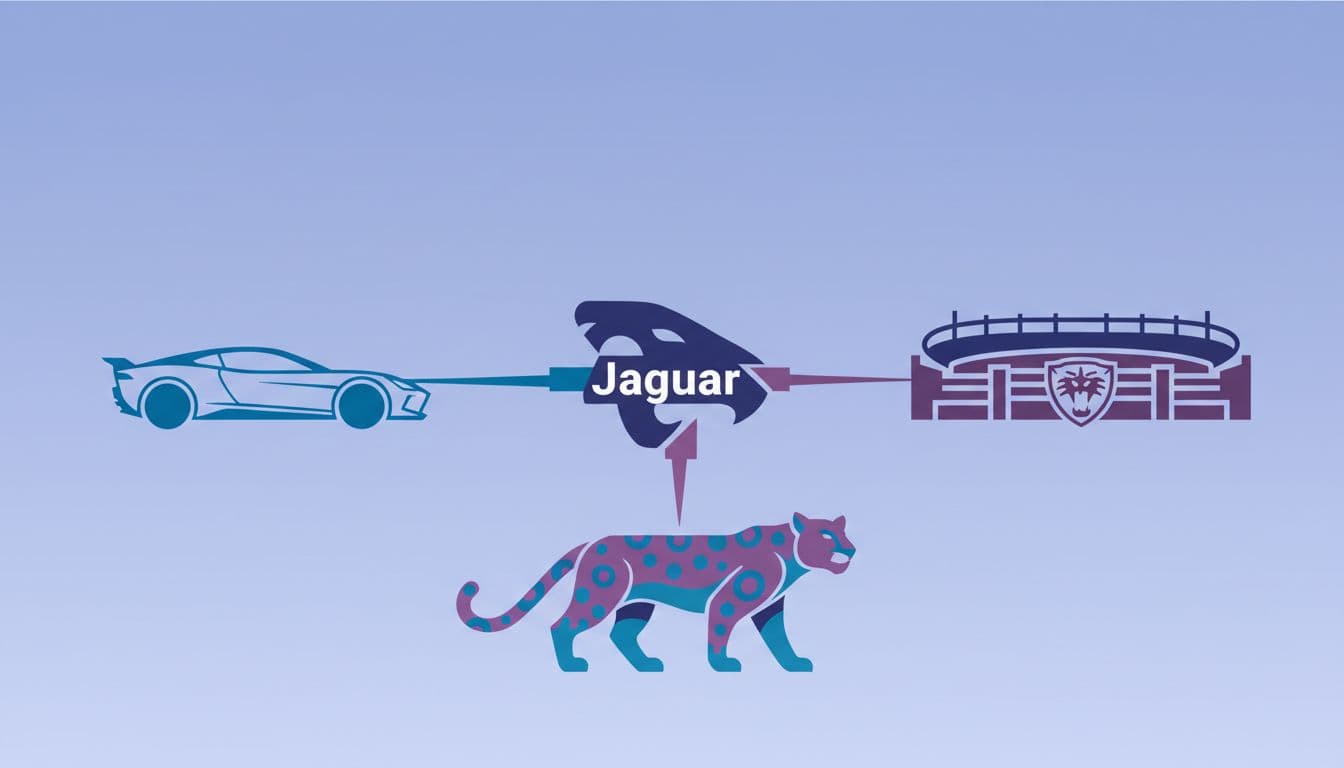
Take “Jaguar.” A user might mean the animal, the car brand, or the Jacksonville NFL team. The word stays the same, but the intent changes completely. Search systems sort that out through entity context with natural language processing, not through keyword matching alone.
Search for “Jaguar animal” and you expect wildlife results. Search for “Jaguar car” and you expect dealer pages, specs, and brand content. The difference is not subtle.
The same issue shows up in B2B categories all the time. A company can target “project management software” well and still lose if Google reads the site as general productivity advice instead of a software brand. When the category match is off, strong content is not enough. The principle also applies to personal brands, where a name like “Jordan” might refer to the basketball icon or unrelated concepts.
That is why brand entity clarity matters so much in crowded markets. Search engines need firm signals about which “thing” your brand is. Authority co-occurrence helps here, as consistent mentions across social media nodes alongside trusted sources corroborate your identity.
What happens when Google classifies you wrong
One case shared in the discussion involved an HVAC company. The business had solid content and strong backlinks, yet Google kept classifying it as a general contractor because the schema markup was wrong.
After the schema was corrected to identify the company as an HVAC specialist, traffic doubled in 90 days.
The content did not suddenly become better. The entity classification changed.
A second example made the same point in software. Before structured data improvements, an enterprise client was categorized as a general software company. After adding product schema that defined the business more precisely as enterprise resource planning software for manufacturing, rankings for manufacturing ERP terms increased 40% in 60 days.
Those examples show why disambiguation is not a side task. It affects how your brand appears across search and AI systems.
A quick audit can reveal where the problem starts:
- Search your company name.
- Check whether a knowledge panel appears.
- Verify that the category, description, and business type are accurate.
If Google does not clearly know what you are, it has little chance of surfacing you for the right searches.
Schema Markup is your digital ID card
Why marketing copy fails machines
Many About pages, serving as the Entity Home, sound polished to people and useless to machines.
A sentence like “We’re a leading provider of innovative solutions” tells an AI crawler almost nothing. It does not define whether the company is SaaS, local service, ecommerce, B2B, or B2C. It does not identify a product type. It does not clarify the market category.
That kind of copy may pass a brand review. It does not help entity recognition.
Schema Markup solves this by translating your business into structured fields that machines can parse directly. Instead of guessing from broad claims, AI systems can read defined attributes.
What schema tells AI that prose does not
A local service example makes this clear. A page might say, “We provide plumbing services in Chicago.” That statement helps a person, but it leaves room for interpretation.
Schema can define the business much more directly:
- business type
- service area
- service categories
- hours of operation
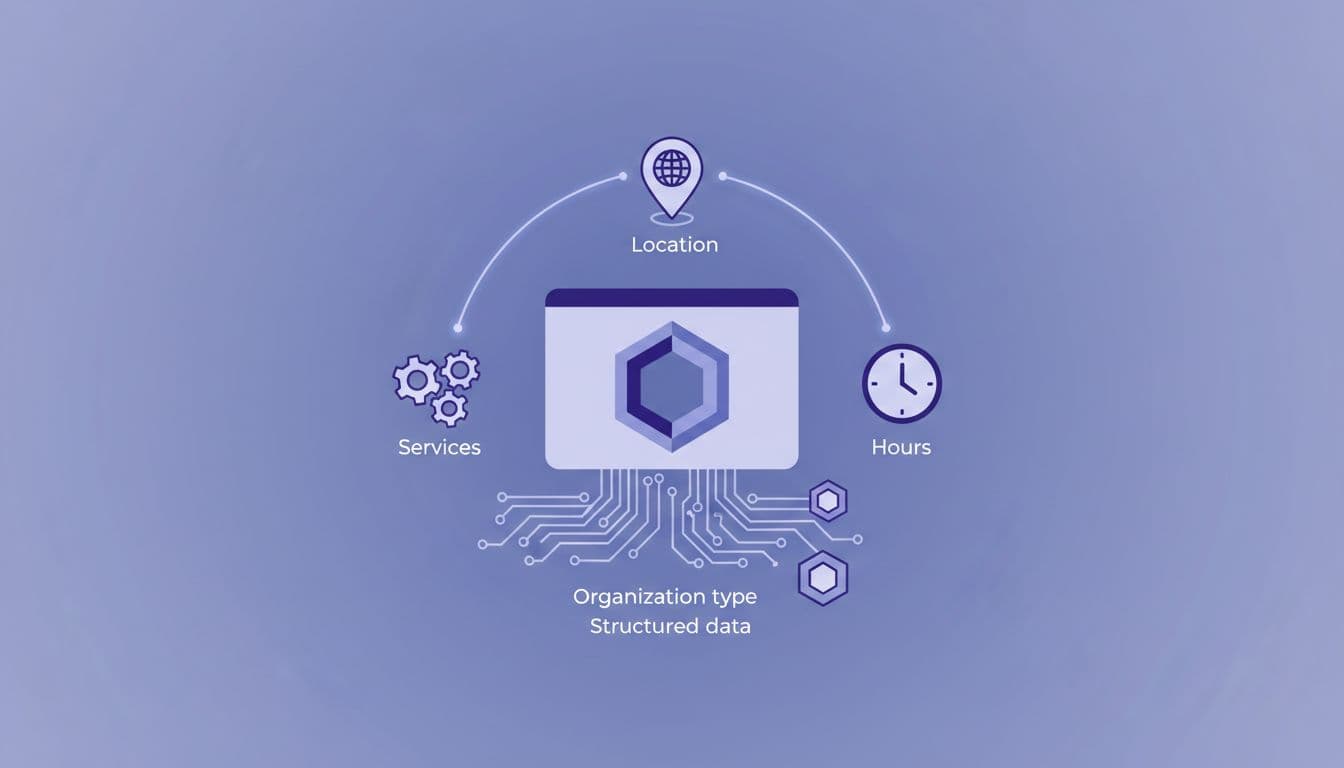
With Schema Markup, Google does not have to infer whether the page is about a local plumber, a home services directory, or a blog post. The page states the entity directly.
That is why Schema Markup works like a digital ID card for brand entity building. It names the company, the offer, the category, the location, and other signals that help AI connect the dots.
The first three schema types to add
Most companies do not need to start with an exhaustive schema library. They need a correct baseline.
These are the first three types mentioned as the minimum starting point:
- Organization Schema, to define the company itself.
- Product or service schema, to define what the company sells.
- Local business schema, when location matters.
After implementation in JSON-LD, the preferred format, test what search engines can read. Google’s Rich Results Test is a practical checkpoint because it reveals whether structured data is present at all and qualifies for Rich Results.
If the tool reports no structured data, AI systems have to rely on guesswork. That is rarely a good position. Platforms like Kalicube offer proven processes for managing brand entities in search.
The complexity moat in AI search
Simple queries get answered, complex queries get cited
One of the strongest ideas in the discussion is that topic complexity creates a moat around your topical authority. The more complex the query, the more likely AI needs source material instead of a quick generic answer.
A study referenced in the talk looked at 4 million queries across six languages. The pattern was clear:
| Query length | AI Overview rate |
|---|---|
| 1 to 3 words | 24% |
| 3 to 5 words | 48% |
| 6+ words | 77% |
Short queries often invite confident, low-detail answers. A search like “best CRM” can trigger a broad response with well-known brands such as Salesforce or HubSpot. Citation may not matter much there because the system can lean on established entity knowledge.
Longer searches are different. Once a user asks for “the best CRM for enterprise SaaS companies managing distributed sales teams across EMEA with Salesforce integration requirements,” the system needs detail. It has to account for geography, team structure, integrations, and business model.
That is where credible sources with strong EEAT matter more.
Why complex topics bring better leads
Complex queries tend to come from buyers doing serious research. They have narrower needs, stronger intent, and less patience for vague content.
The example in the discussion made that tradeoff clear. One client stopped chasing the broad term “email marketing software” and focused on “email deliverability optimized for ecommerce brands sending 1 million plus monthly emails.” Traffic dropped 30%, but revenue increased 200%.
That result makes sense. Broad traffic often includes low-intent visitors. More specific traffic often includes people much closer to a decision.
For CMOs and marketing leaders, this changes how content strategy should be judged. High impressions on simple terms can look good in a report and still produce weak AI citation visibility. Meanwhile, narrower content with strong brand entity signals can win fewer visits and better outcomes.
How to audit content for complexity
A content audit for AI search should embrace semantic SEO and not stop at rankings. It should ask whether your topics are too simple to need you.
Start with the obvious broad terms in your category. Then look for the layered questions that require product knowledge, market context, and real examples. Those are the topics AI is more likely to cite.
A useful review usually includes three checks:
- Remove or de-prioritize pages built around generic, one-layer queries.
- Expand coverage around detailed buying questions in your niche.
- Make sure each page clearly ties the topic back to your brand’s entity and offer.
Complexity alone does not win. It works when it is paired with clarity.
Zero-click search changes the goal
AI agents compress the buying journey
The old model assumed a user would search, compare links, visit websites, and then decide. That path still exists, but AI is shortening it, with tools like Search Generative Experience driving compressed buying journeys.
A buyer might soon ask an AI system to research CRM options for a 20-person remote team, compare the top choices, and book demos with the best fit. In that flow, the AI does not need to send ten blue links. It can synthesize, rank options, and move toward action by analyzing a brand’s complete digital footprint.
That means one vendor may get the meeting while others never enter the consideration set.
For marketers, this changes the job. The goal is not only to attract a click. The goal is to become one of the entities the AI trusts through multi-surface corroboration across platforms enough to mention and act on.
The metrics that matter now
The discussion points to several numbers that support the shift. Google zero-click searches are said to be at 59% and rising. AI Overviews appear on 77% of complex long-tail queries. The share of searches that end in a website click is dropping by 1% to 2% each year, with the pace increasing.
Whether every category moves at the same speed is less important than the direction. Clicks are becoming a less complete measure of visibility, even as branded search signals growing entity strength.
A better scorecard for brand entity building includes questions like these:
- Does your brand earn a knowledge panel?
- Do your pages get cited in AI Overviews?
- Does your company appear when chat-based AI tools discuss your category?
- For local businesses, does a complete Google Business Profile reinforce your entity signals?
Traffic still matters. Rankings still matter. They simply no longer tell the whole story.
Some of the client examples referenced in this discussion came from NP Digital, where the emphasis is less on preserving old traffic patterns and more on winning visibility that leads to revenue even as organic click volume changes.
Frequently Asked Questions
What is a brand entity and why does it matter now?
A brand entity is a singular, unique, well-defined representation of your business, product, or service in search systems like Google’s Knowledge Graph. It matters because AI search no longer relies on keyword matches but draws from entity databases with 54 billion entities and 1.6 trillion facts. Without a clear entity, even high-ranking pages get ignored in AI answers.
How does schema markup help with brand entity building?
Schema markup acts as a digital ID card, providing structured data that explicitly defines your business type, services, location, and relationships in machine-readable JSON-LD format. Vague prose like “leading provider” fails machines, but schema tells AI precisely what you are, improving classification and visibility. Start with Organization, Product/Service, and Local Business schemas, then test with Google’s Rich Results Test.
Why do some brands get misclassified in search?
Misclassification happens when sites lack clear entity signals, leading AI to confuse your brand with similar categories—like an HVAC company seen as a general contractor. Disambiguation relies on context, structured data, and authority co-occurrence to resolve ambiguities, as in “Jaguar” meaning car vs. animal. Correcting schema fixed one HVAC firm’s traffic in 90 days by sharpening entity identity.
How has zero-click search changed SEO goals?
Zero-click searches now hit 59% and rising, with AI Overviews on 77% of complex queries compressing buying journeys without site visits. The goal shifts from clicks to becoming a trusted entity cited by AI across knowledge panels, chats, and generative experiences. Focus on multi-surface corroboration and complex topics for qualified leads over broad traffic.
What are the first steps to build your brand entity?
Start with your entity home (homepage/About page), add Organization schema, optimize Google Business Profile, and seek citations on Wikidata/social profiles. Answer three questions per page: What is it? What category? How does it relate? Use semantic triples and check Knowledge Graph API for progress to ensure AI recognizes you clearly.
Final thoughts
The biggest shift in search is not a new tactic. It is a new standard for identity. Search engines and AI tools want clear entities, not vague pages.
That is why brand entity building deserves a place beside content, technical SEO, and authority work. If your company is not easy for machines to classify, relate, and trust, strong rankings can still leave you out of the answer.
The brands that hold up best in AI search will be the ones that define what they are, mark it up clearly, and publish content detailed enough that AI needs to cite them.
To get started with brand entity building, follow this simple roadmap:
- Identify your entity home (typically your homepage or about page).
- Implement Organization schema markup for structured data.
- Optimize your Google Business Profile for local and knowledge signals.
- Seek multi-surface corroboration through social profiles and third-party citations.
As a final technical tip, focus on semantic triples, the subject-predicate-object relationships that power knowledge graphs (for example, “YourBrand is a CRM provider”). Check your brand entity status via the Knowledge Graph API to gauge progress.