If your review count has stalled, your local visibility does not have to.
It is entirely possible to rank in map pack results without needing a constant stream of new reviews. The most effective strategy involves optimizing your Google Business Profile, ensuring tight local relevance, strengthening website alignment, and establishing clear trust signals across the web.
This approach is vital for CMOs and marketing leaders because review acquisition is often slow and difficult to manage at scale. By prioritizing your Google Business Profile and broader local SEO initiatives, you can address technical gaps and citation accuracy, which often produce faster and more sustainable ranking improvements.
Key Takeaways
- Prioritize Local Fundamentals: You can outrank competitors with more reviews by optimizing core signals like your primary Google Business Profile category, complete profile fields, and NAP (Name, Address, Phone) consistency.
- Align Content with Search Intent: Improve your map pack visibility by ensuring your website service pages directly match the specific intent and location queries associated with your business, rather than relying on generic landing pages.
- Strengthen External Trust Signals: Build prominence by cleaning up local citations across major directories and earning authentic local backlinks from community partners, sponsorships, or industry-specific organizations.
- Focus on Measurable Engagement: Shift your strategy toward increasing clicks, calls, and direction requests by refining your profile’s imagery, Q&A section, and service descriptions to drive action even when your review volume remains static.
Why reviews help, but they are not the only way into the map pack
While customer reviews are a known trust signal, they are not the only path to ranking in local search results. Google explicitly states that rankings are determined by a combination of relevance, distance, and prominence, rather than a single metric.
This means a business with fewer reviews can still climb the rankings if it provides a better match for user queries, maintains cleaner local data, and establishes stronger overall authority online.
| Factor | What it means | Control level |
|---|---|---|
| Relevance | How well your business matches the query | High |
| Distance | The physical proximity to searcher | Low |
| Prominence | How trusted and visible your business appears | Medium to high |
Although distance is difficult to influence, you have significant control over relevance and prominence. When analyzing these core criteria, it helps to understand how they form the foundation of Google maps SEO. Google evaluates these local ranking factors by analyzing your business categories, website content, and overall brand signals across the web. While prominence is influenced by your volume of customer reviews, it is also shaped by inbound links, business citations, and brand mentions.
For most business owners, the most effective strategy is to improve the signals you can actually control. A roofing company with 40 reviews can frequently outrank a competitor with 140 reviews if the smaller listing utilizes the correct categories, optimizes its service pages, and keeps data consistent across online directories. Often, weak technical foundations hold a listing back far more than a lack of new feedback.
If you want a professional assessment of these gaps, get a free consultation to identify specific profile, website, and citation issues before committing time to a new review campaign.
Optimize Your Google Business Profile to Rank in Map Pack
A half-finished profile is like a storefront with the lights off. Google can still find it, but it has less confidence in what you do and who you help. Completing your Google Business Profile is the foundational step for any business looking to improve its local visibility.
### Choose the most accurate primary category
Your primary category shapes which searches you can show up for. When selecting your business categories, pick the label that matches your main revenue driver rather than the broadest label you can claim.
For example, pediatric dentist is usually stronger than dentist if children’s care is the core service. Secondary business categories help too, but the primary one does most of the heavy lifting for your search rankings.
Fill out every core field that supports rankings
Before you dive into granular updates, ensure you have completed the verification process to confirm your business legitimacy. Once verified, fill out every core field, including your business description, services, hours, phone, website, service areas, attributes, and booking links. Missing fields weaken both relevance and trust.
A well-crafted business description provides Google with the context it needs to associate your listing with the right search queries. If your profile says one thing and your website says another, Google has to guess, which is rarely good for rankings. For a broader view of which local signals carry the most weight, this local ranking factor breakdown is a useful reference.
Use photos, posts, and Q&A to show the profile is alive
Fresh photos help users trust the listing before they click. Regular updates via Google posts show activity, while helpful Q&A sections reduce friction for potential customers.
Add team photos, project images, seasonal updates, and short answers to common objections. A med spa might post treatment room photos and aftercare tips, while a home services brand might post before-and-after projects and weekend availability. Keeping your information current and engaging is one of the most effective ways to master Google maps seo and keep your business ahead of the competition.
Make your website match the search intent behind the listing
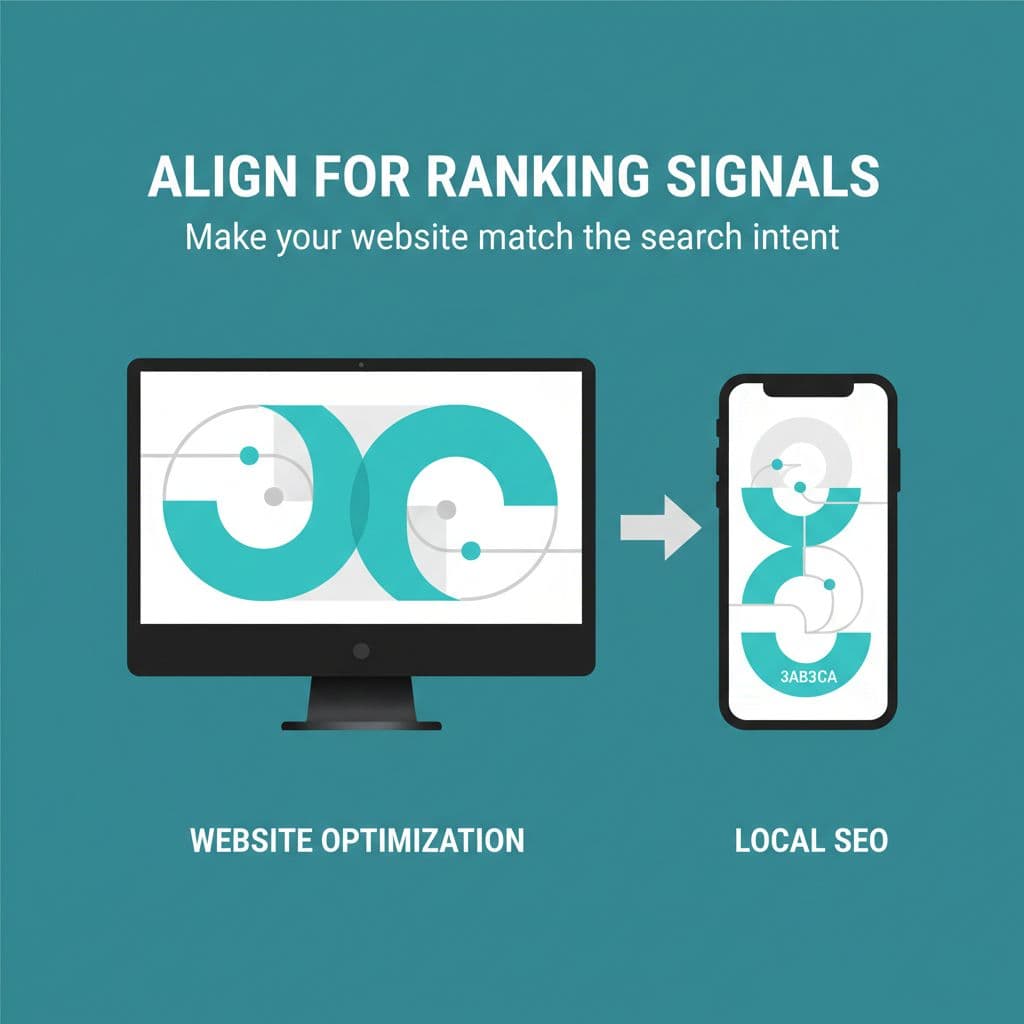
Your website acts as the primary validation for your Google Business Profile. If your profile advertises emergency plumbing, the linked landing page must fulfill that promise rather than serving as a generic homepage. To satisfy the search intent behind the listing, every page on your site should be built to answer specific user needs while establishing your local authority.
### Build city specific service pages for your main offers
Each core service you provide needs its own dedicated page. If you offer HVAC repair and HVAC installation, create separate landing pages for each. These city specific service pages should clearly name the service, explain the outcome, show proof through project photos, and answer common customer questions.
When creating these pages, incorporate clear location signals naturally. Use city and service-area terms in your page titles, headings, and introductory copy. For example, “Same-day AC repair in Phoenix” is effective, whereas repeating “Phoenix AC repair” multiple times in a single paragraph feels forced and harms readability. To further bridge the gap between your site and your listing, implement LocalBusiness schema markup; this code helps search engines explicitly connect your website data to your map listing. You can review this Google Maps and Map Pack overview to better understand how to align your site signals with your profile.
Prioritize NAP consistency and user experience
Beyond the content itself, maintain strict NAP consistency (Name, Address, and Phone number) across your header, footer, contact page, and all service pages. Search engines prioritize websites that present a unified business identity across every touchpoint.
This consistency signals reliability to both search crawlers and potential customers. Ensure your contact details are prominently displayed so mobile users can tap and call without searching for the information. By keeping your business details uniform and your service pages well-structured, you build the trust required to rank higher in the map pack without needing a constant influx of new reviews.
Build trust signals outside Google without relying on reviews
Google looks beyond your profile. It wants proof that your business is real, established, and tied to the market you claim to serve. Establishing these external signals is essential for improving your standing in local search results.
### Clean up your citations on trusted platforms
Start with Yelp, Bing Places, Apple Maps, Facebook, and the top industry directories in your space. Consistency is key, so keep your business name, address, phone number, hours, and website identical across all local directories.
One outdated suite number or one old tracking number can create doubt for both users and algorithms. Diligent maintenance of your local citations is dull work, but it often fixes hidden trust problems that prevent your business from being recognized as a legitimate local entity.
Earn local links that prove you belong in the area
A few quality local backlinks beat a pile of weak submissions. Focus your efforts on chambers of commerce, supplier pages, sponsorships, neighborhood groups, partner sites, and local publications.
For example, sponsoring a youth sports league or speaking at a local business event can earn a relevant link and a branded mention. Both help prominence and provide a clear indicator to search engines that your business is a fixture within the community.
Use mentions and partnerships to strengthen prominence
Not every mention needs a live link to matter. Community visibility, local partnerships, and branded searches all support the idea that your business is known in the area.
Building this level of brand authority is a vital component of your overall online reputation. A business people recognize gets more clicks, more branded searches, and better engagement. This digital footprint matters more than many marketers admit because it proves to search engines that you are a trusted local authority.
What to do when reviews are not growing but rankings still need to improve
If the growth of your customer reviews is flat, do not wait around. Keep your Google Business Profile active and refine how users interact with your listing to advance your map pack optimization efforts.
Encourage more clicks, calls, and direction requests
Sharpen the message on your profile to provide value. Use high-quality photos, clear service descriptions, and compelling reasons to choose you, such as same-day scheduling, financing options, or weekend availability.
Even if your star rating remains static, these optimizations can improve user engagement and conversion rates before your rankings even shift. If your team needs a concrete next step, audit your listing against the top three competitors in your area this week.
Respond to existing reviews the right way
Yes, replying to previous customer reviews still helps your visibility. It demonstrates that the business is active, builds trust, and provides prospects with more context about your services.
Keep your replies short and useful. Thank the customer, mention the service you provided naturally, and address any concerns with a professional tone. Avoid canned responses that sound copied and pasted, as original content is more effective for building long-term trust.
Track what changes actually move the listing
Monitor your profile views, calls, website clicks, direction requests, and booked appointments. To effectively measure progress, use GeoGrid reports to track your local keyword visibility and local ranking trends over time. Then, change one element at a time to isolate what is working.
If your rankings rise after you update your categories or service pages, you have successfully identified a constraint. If you do not see an immediate shift, move on to cleaning up your citations, building local links, or adding stronger photos to your profile.
Common mistakes that keep businesses stuck below the map pack
Many common local SEO hurdles are not particularly difficult to overcome, yet they persist for months simply because business owners fail to question their current strategies.
Stuffing keywords into the business name or profile
Adding extra keywords to your business name often violates Google guidelines and invites unwanted profile edits or account suspensions. Beyond the risk of penalties, this tactic ignores the most important local ranking factors. Instead of trying to game the system, focus on building legitimate relevance and trust, as Google may trigger a local filter that suppresses your listing if it detects manipulative naming conventions.
Using weak location pages that all say the same thing
Creating duplicate city pages does nothing to build local authority. These thin pages waste your crawl budget, create a poor user experience, and signal to search engines that your content lacks value. Only build out unique area pages when you can provide verifiable proof of service, specific service details, and genuine local context.
Ignoring proximity and expecting a loophole
You cannot beat physical distance in every search query. If a user is located much closer to a strong competitor, that result will likely win the top spot. Instead of chasing impossible rankings, focus your efforts on the neighborhoods, ZIP codes, and service terms where your business already has a fair shot. That is where your optimization efforts will pay off with real visibility.
A simple 30-day plan to improve Google 3 pack visibility without asking for more reviews
You don’t need a giant local SEO project to get started. You need one month of focused cleanup.
Week one, clean up the profile and core website pages
Check your categories, hours, services, phone numbers, attributes, and business description. Ensuring these are accurate is the most important step to optimize your Google Business Profile. Then, update your top service pages so they match the profile and make local intent obvious for searchers.
Week two, add local proof and trust signals
Clean up your local citations and ensure your business information is consistent across all local directories. Upload fresh, geo-tagged content like photos to your listing, publish one Google Post, and add proof on-site through project photos, case studies, FAQs, or team pages. Reach out to local partners for relevant mentions or backlinks to further build authority.
Week three, monitor engagement and tighten the message
Review how people interact with the listing. If impressions are high but calls are low, your photos, offer, or service descriptions may be weak. Adjust your messaging to clearly address the pain points of your target audience.
Week four, review results and decide what to test next
Compare calls, clicks, direction requests, and local rank tracking against your baseline. Keep the strategies that helped, then test the next likely constraint, which is usually categories, service copy, or the consistency of your local data.
Final Thoughts
If your listing is stuck below the top three, waiting for more reviews is often the slowest fix. You can improve your ability to rank in the map pack much faster when your profile is complete, your pages match search intent, and your authority is built on a solid foundation of local ranking factors.
Start by focusing on the signals Google already trusts. Then, track the small changes that drive more calls, clicks, and direction requests.
If you want a second opinion before the next reporting cycle, request a professional audit of your current local SEO setup and fix the highest impact gaps first.
FAQ
Can you rank in Google Maps with fewer reviews?
Yes. Better categories, stronger service pages, complete profile data, and cleaner citations can outweigh a review gap in many local searches. Improving your domain authority through high-quality local content also helps Google view your site as an expert, often compensating for a lower star rating compared to your competitors.
How long does it take to improve map pack rankings without new reviews?
It depends. Profile edits can affect visibility within weeks, while citation cleanup and local link work often take 30 to 90 days.
Do Google Posts help local rankings?
Yes, indirectly. Posts keep the profile active and can improve clicks and trust, even if they are not a top ranking factor by themselves.
What matters more for local SEO, categories or reviews?
Categories often matter first because they define relevance. Reviews help prominence and conversion, but the wrong category can block visibility before reviews matter.
Can a service-area business rank without showing its address?
Yes. A service-area business can rank if the profile follows Google’s rules and the website clearly supports the cities and services it targets.
Can I use a co-working space address for my Google Business Profile?
Generally, no. Google requires that you have a permanent, staffed office space. Using a co-working space address often violates their guidelines unless you have a dedicated, private office with clear signage, as shared or virtual office addresses are frequently flagged or suspended by Google.
Are sponsored results the same as organic map pack listings?
No. Sponsored results are paid advertisements that appear at the top of the local search results, while organic map pack listings are earned through local SEO efforts and relevance. While sponsored results provide immediate visibility, focusing on your organic presence ensures long-term traffic that does not disappear when you stop paying for ads.